Automating Public Tender Review with AI and n8n
From hundreds of procurement notifications to actionable summaries, delivered to the sales team in minutes
The problem: Relevant tenders lost in the noise
Public procurement portals publish hundreds of tenders every day. For a technology company looking to win government contracts, each notification could be an opportunity, or far more likely, irrelevant noise. The Lithuanian public procurement portal (viesiejipirkimai.lt) alone generates a steady stream of notices covering everything from road construction to catering services to IT infrastructure.
Finding the tenders that actually match your capabilities means reading through all of them. Consider what a single tender evaluation involves:
- Volume overwhelm - dozens of notifications arrive daily, each requiring manual review just to determine basic relevance.
- Multi-document analysis - a single tender typically includes notice documents, contract specifications, and technical requirements spread across multiple PDFs and DOCX files. Evaluating one tender means downloading and reading them all.
- Language and structure barriers - tender documents follow formal procurement language, often in Lithuanian, with critical details buried deep in dense legal and technical text.
- Slow response cycles - by the time someone manually reviews a tender, extracts the key details, and briefs the sales team, days may have passed. In competitive procurement, that delay matters.
- Inconsistent coverage - when review depends on one person's availability, tenders get missed. Holidays, busy weeks, or simple inbox overload create blind spots.
Multiply that across dozens of daily notifications, and the math stops working. We decided to automate the entire chain.
The solution
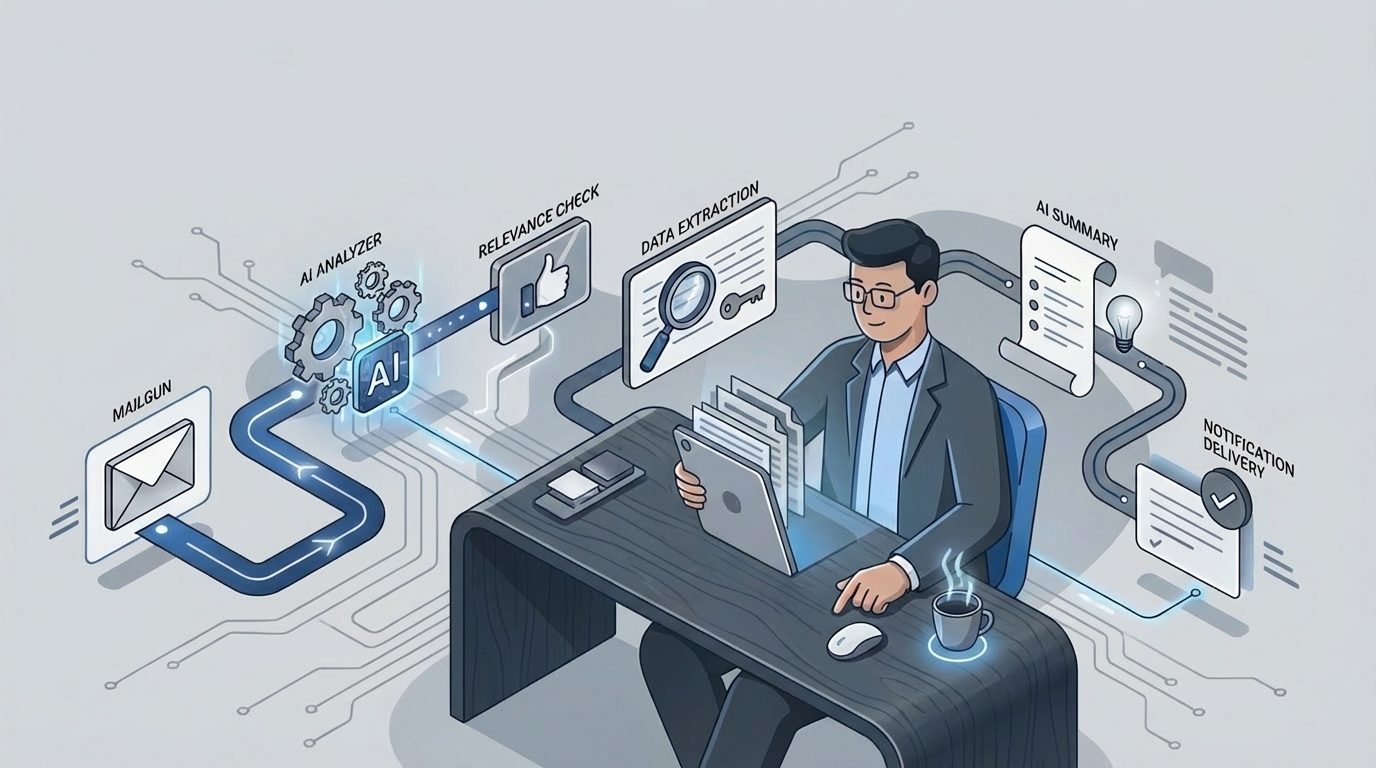
The Public Tender Review & Summary Notification System is an automated pipeline that monitors incoming tender notifications, determines whether each one is relevant to our capabilities, extracts structured information from both the tender page and its attached documents, and delivers a comprehensive summary to the sales team, all without manual intervention.
The full pipeline runs from email reception to summary delivery.
Here is what each stage of the pipeline handles:
1. Filters and classifies incoming tenders automatically
The pipeline monitors a dedicated email address connected to the Lithuanian public procurement portal. When a notification arrives, the system immediately checks whether it is a genuine tender publication, filtering out unrelated correspondence at the gate.
For confirmed tender emails, an AI model extracts the tender link and fetches the full tender page. A second AI pass then reads the tender title, description, and metadata to answer a single question: is this tender relevant to technology solutions software development, IT services, digital platforms, or infrastructure? Only tenders that pass this relevance check continue downstream. Everything else is discarded silently, saving the team from ever seeing it.
2. Extracts structured data from tender pages and documents
For each relevant tender, the system performs two levels of extraction.
First, it analyzes the tender page itself and pulls out 36 structured fields, covering everything from basic identification to strategic decision-making data.
| Category | What It Captures |
| Identification | Tender title, unique ID, organizer name, CPV and NUTS codes |
| Financials | Estimated value in EUR, EU funding status, international threshold |
| Timelines | Submission deadline, clarification period, invitation date, contract duration |
| Requirements | Evaluation criteria, contract type, tender method, alternative offers policy |
| Logistics | Publication language, winner determination method, parts/categories split |
Second, the system discovers and downloads all attached documents, both notice documents and contract specification files. It handles multiple file formats, extracting text from PDFs and DOCX files alike. Each document is then analyzed by an AI model under strict factual extraction rules: pull out what is explicitly stated project scope, technical stack, performance requirements, budget, risk factors and leave out anything that would require guessing.
3. Generates and delivers a comprehensive tender overview
All extracted information from the tender page fields, the AI-generated summary, and the factual extractions from every attached document is consolidated into a single, comprehensive project overview.
A final AI pass merges and deduplicates the collected facts, resolves any conflicts by deferring to the tender page summary, and produces a formatted HTML document. The overview includes the tender link, a description of what is being built, the requesting organization, budget and timeline, technical requirements, and any risk factors structured for quick scanning.
This overview is emailed directly to the sales team. Within minutes of a relevant tender being published, the team has everything they need to decide whether to pursue it.
How it works under the hood
Under the surface, a 30-node n8n workflow coordinates the full pipeline combining webhook triggers, AI-powered analysis, headless browser automation, and multi-format document processing.
Email reception and filtering - A Mailgun webhook activates the pipeline when an email arrives at the designated address. The system checks whether the subject line indicates a genuine tender publication. Emails that do not match are discarded immediately.
Tender link extraction - For valid notifications, an AI model parses the email body to extract the tender URL and resource identifier from the procurement portal.
Page fetching and relevance assessment - The system fetches the full tender page via HTTP request. An AI model then extracts 36 structured fields from the HTML and simultaneously evaluates whether the tender relates to technology solutions. Non-relevant tenders exit the pipeline here.
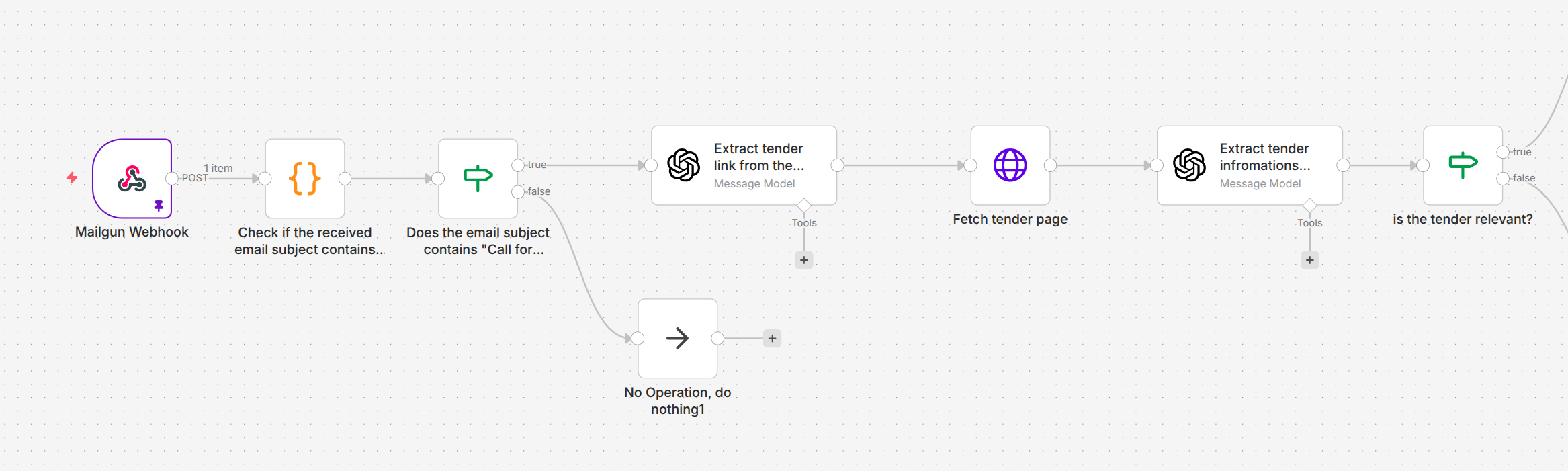 Phase 1: Incoming emails are intercepted, parsed, and filtered using AI to ensure only relevant technology tenders proceed.
Summary generation - For relevant tenders, a separate AI pass generates a concise, professional summary from the structured fields capturing the essence of the opportunity in a format optimized for quick review.
Document discovery - A headless browser navigates the procurement portal to locate all attached documents: notice files and contract specification files. The workflow collects download links and document identifiers across both categories.
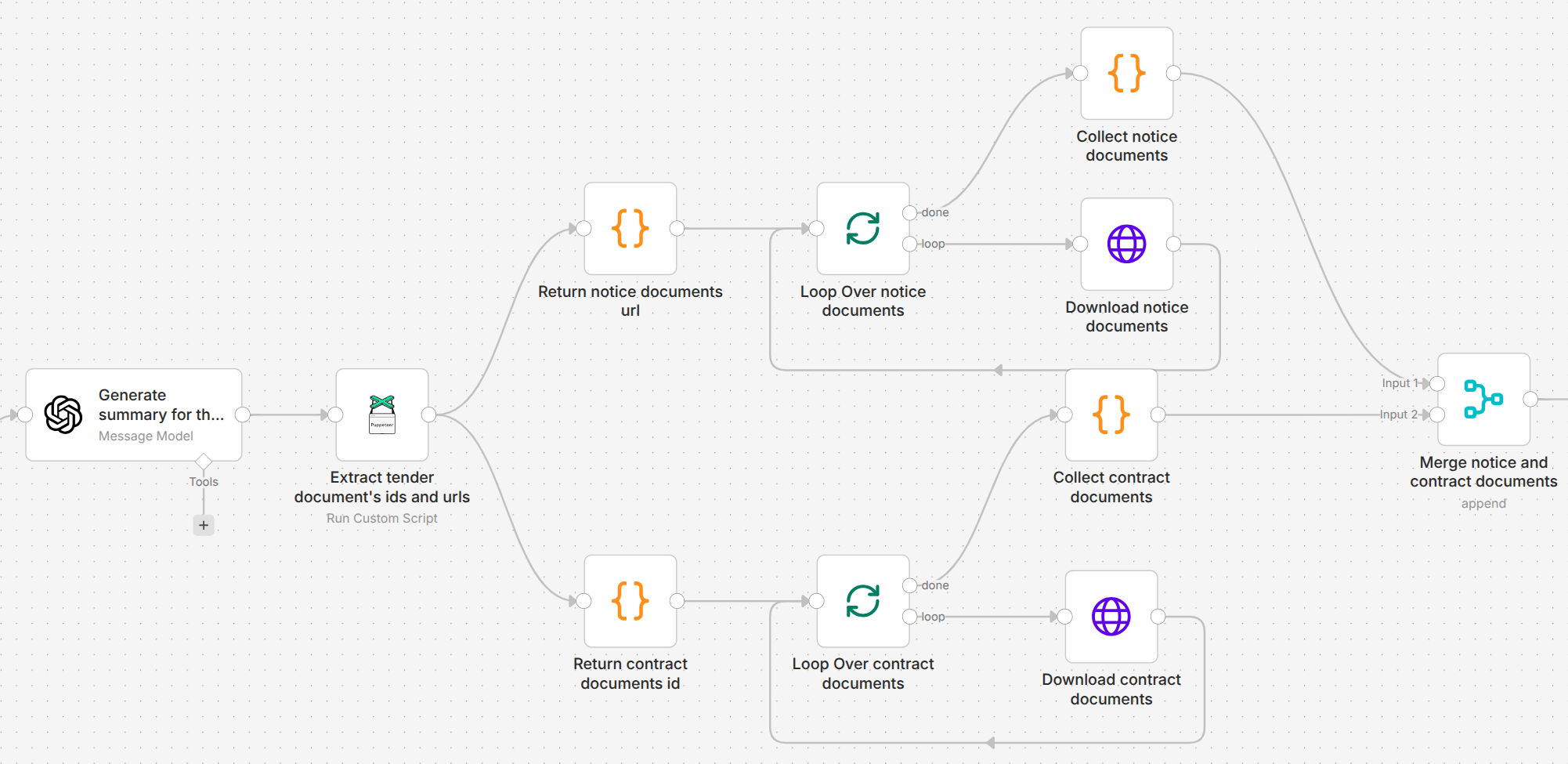 Phase 2: The system splits into parallel processes to systematically discover and download every attached notice and contract document.
Document processing and factual extraction - Each document is downloaded, routed to the appropriate text extractor based on file format, and analyzed by an AI model. The extraction follows strict rules only explicitly stated facts are captured. No inference, no assumptions, no gap-filling.
Consolidation and delivery - A final AI model receives all extracted facts from every document alongside the tender summary. It produces a single, structured HTML overview deduplicated, coherent, and ready to read. The overview is emailed to the sales team automatically.
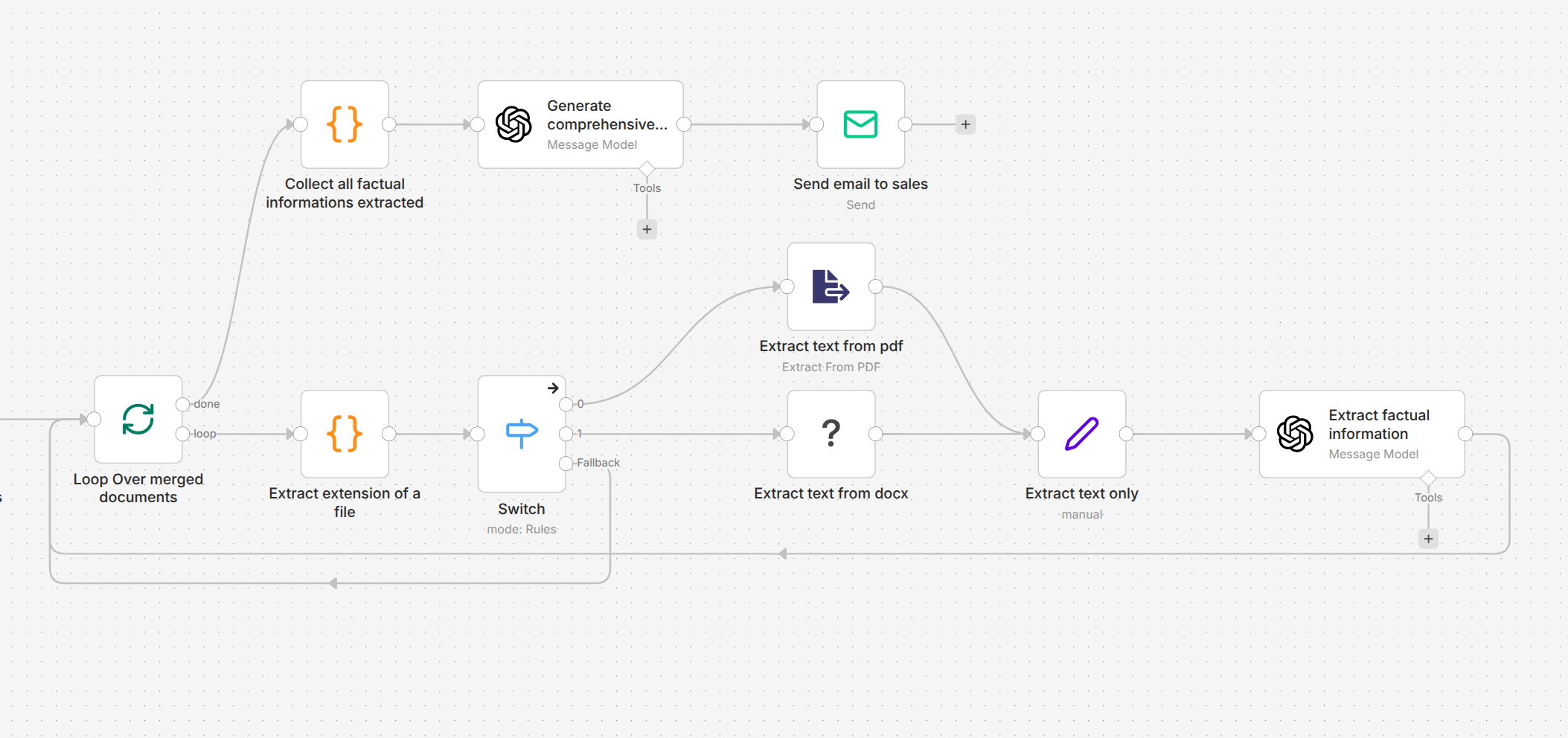 Phase 3: Multi-format documents are routed for text extraction, analyzed by AI for key facts, and consolidated into a final email brief.
The impact
The difference between manual review and automated review is stark not just in time, but in consistency, coverage, and speed to action.
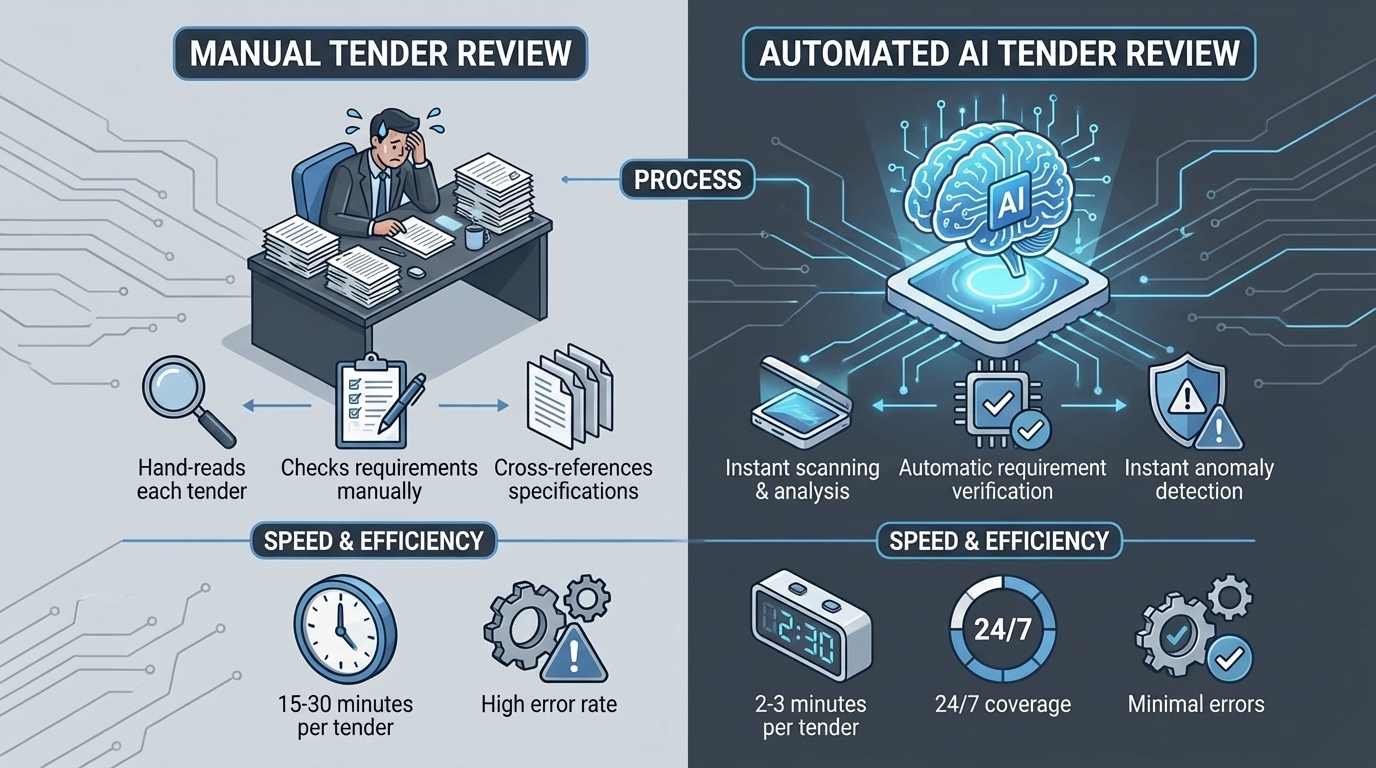 Manual review versus automated AI review
Before: A team member spends part of every day scanning procurement emails, opening tender pages, downloading attached documents, reading through Lithuanian legal and technical text, and compiling notes for the sales team. A single tender takes 15 to 30 minutes to properly evaluate. With dozens of notifications daily, relevant opportunities get buried, delayed, or missed entirely.
After: The sales team receives a formatted, comprehensive tender overview in their inbox within minutes of publication covering the project scope, budget, timelines, technical requirements, and risk factors. No one opens a procurement portal. No one downloads a document. The team focuses entirely on deciding which tenders to pursue and preparing proposals.
In concrete terms:
- Review time dropped from 15–30 minutes per tender to near zero - the system handles screening, extraction, and summarization end-to-end.
- Coverage became continuous - every relevant tender is caught, regardless of when it is published or who is available to check.
- Summaries are consistent and complete - structured extraction eliminates the variability of manual note-taking and ensures no critical detail is overlooked.
- The sales team responds faster - receiving actionable intelligence within minutes of publication gives the team a head start on competitors still manually browsing the portal.
What comes next
Lithuanian public procurement is the starting point. The architecture is designed to grow in several directions:
- Multi-portal coverage - extending the pipeline to monitor procurement portals in other EU member states, broadening the opportunity landscape.
- CRM integration - writing relevant tenders directly into the opportunity pipeline, linking each one to the corresponding summary and source documents.
- Historical pattern analysis - tracking which types of tenders the team wins most often, and using that data to refine the relevance scoring over time.
- Consortium matching - cross-referencing tender requirements with known partner capabilities to suggest team compositions early in the evaluation process.
- Proposal drafting support - using the extracted requirements and historical winning proposals to generate first-draft proposal outlines.
Key takeaway
Public procurement is a race where the starting gun fires silently, a new tender published on a portal, easy to miss, easy to deprioritize, easy to evaluate too late. The Public Tender Review & Summary Notification System removes that risk by ensuring the sales team receives a comprehensive, structured briefing within minutes of publication, every time, without exception.
The deeper lesson is that this pattern event-driven monitoring, AI-powered classification and extraction, automated delivery applies far beyond tenders. Any domain where high-volume, document-heavy notifications require fast human decisions is a candidate for the same approach. We started with Lithuanian public procurement. The architecture does not stop there.